Relaxed Memory Model Zoo
A living survey of published weak memory models
The Relaxed Memory Model Zoo is a living survey of weak memory models: 107 models spanning 47 years — hardware, programming language, distributed and transactional — and 161 relations between them, ordered by the inclusion of the behaviours they allow. A time slider makes the chronological development of the field explorable, and the dataset behind the map is machine-readable.
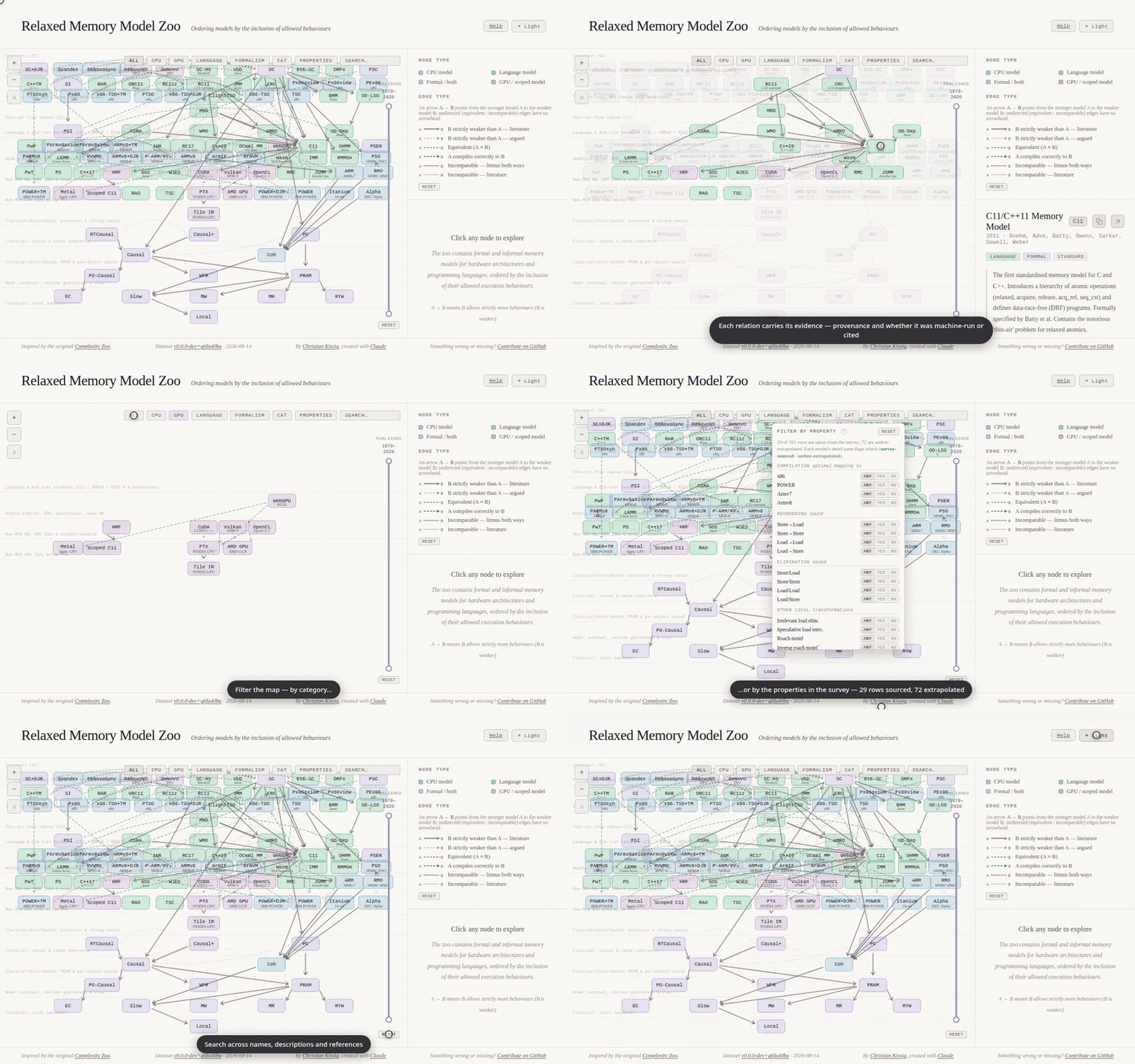
Every model and every edge carries provenance naming the original publication, and every ordering claim states how it is known: a litmus test in the repository that runs and produces the verdict, a mechanical comparison of the two models with kater or memalloy, an argument by construction, or a citation to the primary source. 85 herd7 checks against a pinned herdtools7 and 6 kater containment proofs run on every push, and an edge that contradicts the transitive closure of the others fails the consistency gate before it can ship.
The dataset lives in
rmm-zoo-dataset, which
is where corrections and additions go. If the Zoo is useful to you, follow the
repository on GitHub — that is the signal I go by. Should it prove useful to
the community, the Zoo will move off this subdomain and onto a domain of its
own.
Related
- Blog post: The Relaxed Memory Model Zoo (15 August 2026)